
Table of Contents
If you are reading this, you are likely a devoted cat parent asking yourself a scary question: Can cats get COVID?
Perhaps you just tested positive, or maybe you noticed your feline friend sneezing and acting lethargic. The bond we share with our pets is deep, and the thought of passing an illness to them—or them getting sick from the world around us—is a source of genuine anxiety for many.
Take a deep breath. While the answer to your question is yes, the reality is far less frightening than the headlines might suggest.
In this guide, we will cut through the noise and medical jargon. You will learn exactly how COVID-19 affects cats, what symptoms of COVID in cats to look for, and the practical steps you need to take to keep your entire household—two-legged and four-legged—safe and healthy.
The Short Answer: Can Cats Get COVID-19?
Yes, cats can get COVID.
According to the Centers for Disease Control and Prevention (CDC) and the American Veterinary Medical Association (AVMA), cats are among the pets that are susceptible to the virus that causes COVID-19 (SARS-CoV-2).
However, there is a crucial distinction to make immediately: Getting infected is not the same as getting seriously ill.
While cats can contract the virus, usually through close contact with humans, serious complications are rare. Most cats who test positive show either mild symptoms or no symptoms at all. They are incredibly resilient, but understanding the risks helps you protect them better.
Symptoms of COVID in Cats: What to Watch For
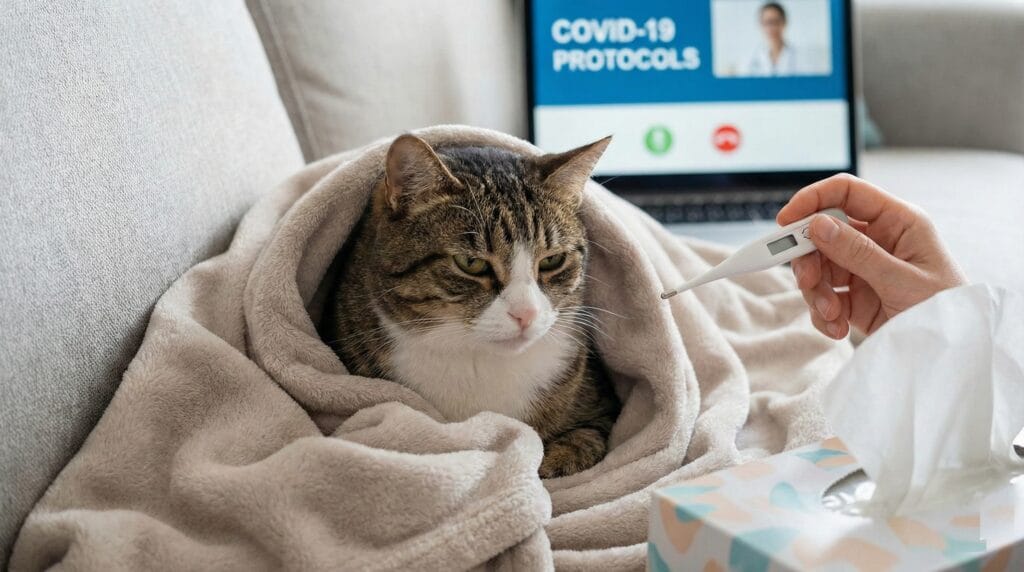
If you are worried that your pet might have contracted the virus, you need to know what signs to look for. Cat COVID symptoms often mirror mild respiratory infections in humans.
Watch for this checklist of clinical signs:
- Fever (A warm nose is not a reliable test; look for lethargy and warm ears/paws).
- Coughing (This may sound like a dry hack or attempting to clear a hairball).
- Difficulty breathing or shortness of breath (Rapid, shallow breaths).
- Sneezing and runny nose.
- Eye discharge (Watery or goopy eyes).
- Lethargy (Unusual tiredness or lack of interest in play).
- Digestive issues (Vomiting or diarrhea).
When to Call the Vet
If your cat has these symptoms, do not panic. These signs overlap with many common feline ailments, such as upper respiratory infections (feline herpesvirus or calicivirus) or even seasonal allergies.
Action Step: If your cat is breathing with an open mouth or their gums look pale/blue, this is an emergency. Seek veterinary care immediately.
Transmission: How Do Cats Catch It?
Understanding transmission is the best way to lower risk. The primary route of transmission is Human-to-Cat (Reverse Zoonosis).
“Can I Give My Cat COVID if I Test Positive?”
This is one of the most searched long-tail keywords for a reason: owners are worried about being the source.
Yes, you can give your cat COVID if you test positive.
Most documented cases of pets getting sick happened after they were in close contact with an owner who had COVID-19. The virus spreads through respiratory droplets (coughing, sneezing, talking) that your cat can inhale if they are snuggling on your chest or sleeping on your pillow.
Can Cats Spread COVID to Humans?
Currently, the risk of a cat spreading COVID-19 back to a human is considered extremely low. While it is scientifically possible, there is very little evidence suggesting that pets play a significant role in spreading the virus to people. You are much more likely to catch COVID from your neighbor than your cat.
Important Comparison: COVID-19 vs. Feline Coronavirus (FIP)

Many cat owners are confused because they have heard of “coronavirus” in cats long before 2019. It is vital to distinguish between the two:
| Feature | SARS-CoV-2 (COVID-19) | Feline Enteric Coronavirus (FeCV) |
| Primary Host | Humans (can infect cats) | Cats (specific to felines) |
| Common Symptoms | Respiratory (Cough, sneeze) | Mild diarrhea (or asymptomatic) |
| Severity | Usually mild in cats | Usually mild, BUT can mutate into FIP |
| FIP Risk? | No link to FIP | Can mutate into Feline Infectious Peritonitis (Fatal) |
| Vaccine? | No commercial pet vaccine needed | FIP vaccines exist but are rarely used |
Key Takeaway: The virus causing the global pandemic (COVID-19) is different from the feline coronavirus that causes FIP. Your cat getting COVID-19 does not mean they will develop FIP.
Practical Advice: What to Do If You Are Sick
If you have tested positive for COVID-19, follow this step-by-step protocol to protect your pet.
1. Isolate Yourself
Treat your cat like a human family member. If you are isolating from your spouse or kids, try to isolate from your cat, too.
- Do not let them sleep in your bed.
- Do not snuggle, kiss, or let them lick your face.
- Do not share food with them.
2. Designate a Caretaker
If possible, ask another member of your household to feed and care for the cat while you are sick.
3. Safety Measures (If You Must Care for Them)
If you live alone or are the sole caretaker:
- Wash your hands thoroughly before and after handling their food, water, or litter box.
- Wear a mask while you are preparing their food or are in the same room.
- Ventilate your home by opening windows if weather permits to clear airborne particles.
Real-World Scenario: A Case Study
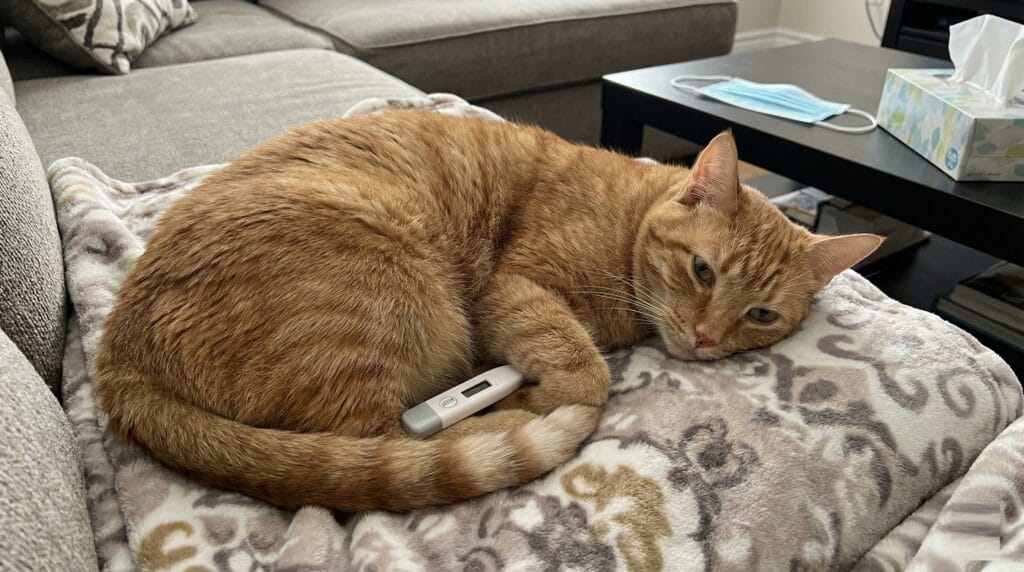
This is a generalized example based on veterinary reports.
The Scenario:
Sarah, a 30-year-old teacher, tested positive for COVID-19. She lives in a small apartment with her tabby, “Luna.” Because of the small space, Sarah couldn’t fully isolate from Luna. Three days into Sarah’s illness, she noticed Luna was sneezing and sleeping much more than usual.
The Action:
Sarah didn’t rush Luna to the ER, which would have exposed vet staff to COVID. Instead, she:
- Called her vet: She explained she was positive and Luna was showing mild symptoms.
- Monitored at home: The vet advised keeping Luna hydrated and watching her breathing.
- Recovery: Sarah wore a mask around Luna for the next 5 days. Luna’s sneezing stopped after 48 hours, and she was back to chasing laser pointers before Sarah even tested negative.
The Lesson: Most cases are mild and manageable at home with common sense and observation.
Conclusion
So, can cats get COVID? Yes, they can. But should this keep you up at night? Hopefully not.
While the virus can jump from humans to felines, our cats are remarkably resilient against it. By recognizing the symptoms of COVID in cats—like coughing and lethargy—and practicing good hygiene if you fall ill, you can effectively minimize the risk.
Remember, your cat is more than just a pet; they are a source of comfort. If you are sick, the best thing you can do for them is to focus on getting better yourself while keeping a safe, loving distance.
What to do next?
If you currently have COVID-19 and are worried about your cat, wash your hands right now before touching their food bowl next. It is a small, simple step that makes a big difference.
Disclaimer: This article is for informational purposes only and does not constitute veterinary advice. Always consult your veterinarian for specific health concerns regarding your pet.
FAQs: Your Top Questions Answered
Should I get my cat tested for COVID-19?
Routine testing for cats is not recommended. Vets typically only test pets if they have severe symptoms and have ruled out other common causes (like heart disease or asthma), especially if there is a known link to a COVID-positive human.
Can I put a mask on my cat?
Absolutely not. Masks can cause distress and breathing difficulties for pets. Never attempt to put a face covering on an animal.
Can I wipe my cat down with sanitizer?
Hand sanitizers, alcohol, and chemical disinfectants can be toxic to cats if ingested (which happens when they groom themselves). If you are worried about virus particles on their fur, a simple wipe with a damp cloth or a pet-safe bath is sufficient, but generally unnecessary.
Are outdoor cats at higher risk?
Outdoor cats have a higher risk of encountering various diseases, but their risk of catching COVID specifically depends on their contact with infected humans, not the outdoors itself. However, keeping cats indoors is always the safest option for their overall health.
Can cats get long COVID?
There is currently no scientific evidence suggesting that pets experience “Long COVID” in the same way humans do. Most recover fully and quickly.
Primary Medical & Veterinary Sources:
1. Centers for Disease Control and Prevention (CDC)
- Topic: Official guidelines on risk, transmission, and what to do if you are sick.
- Link: CDC: If You Have Pets | COVID-19
2. American Veterinary Medical Association (AVMA)
- Topic: Detailed veterinary data on SARS-CoV-2 in animals and clinical signs.
- Link: AVMA: SARS-CoV-2 in Animals
3. Mayo Clinic
- Topic: Expert medical answers regarding transmission between humans and pets.
- Link: Mayo Clinic: COVID-19 and Pets FAQ
4. Cornell Feline Health Center
- Topic: The critical difference between COVID-19 and Feline Coronavirus (FIP).
- Link: Cornell University: Feline Infectious Peritonitis (FIP)