Table of Contents
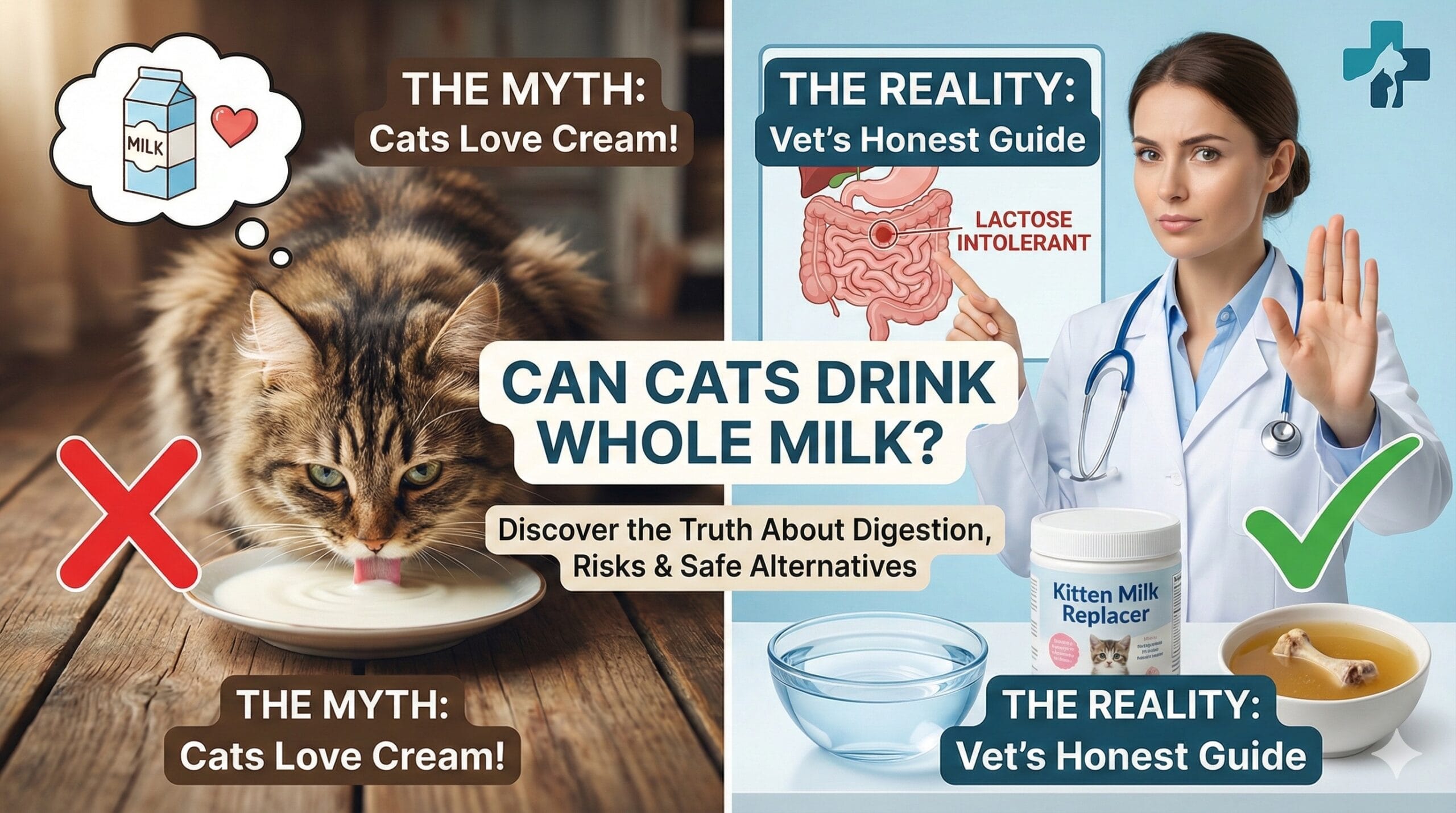
If you grew up watching cartoons, you probably assume the answer to can cats drink whole milk is a resounding yes. The image is etched into your brain: a happy cat lapping up a saucer of warm, white milk. It looks iconic. It looks natural. But as a veterinarian with years of experience treating tummy troubles in felines, I’m here to tell you that this classic image is one of the most misleading myths in pet care.
The short answer : No, you should not give your cat whole milk. While it’s rarely toxic, it can cause significant health issues.
In this deep dive, we’ll explore the biology behind why milk effectively turns into a digestive bomb for most cats, when (if ever) it’s safe, and the better alternatives that will actually keep your kitty healthy.
The Biology: Why Cats Are (Mostly) Lactose Intolerant
To understand why whole milk is a problem, we have to look at your cat’s digestive enzymes.
Lactose is the sugar found in milk. To digest it, a body needs an enzyme called lactase, which breaks that sugar down into absorbable energy.
- Kittens: When kittens are born, they have high levels of lactase because they need to digest their mother’s milk.
- Adult Cats: As kittens wean (usually around 8 weeks old), their bodies naturally stop producing this enzyme.
By the time your cat is an adult, they are effectively lactose intolerant. When an adult cat drinks whole milk, that lactose sits undigested in their gut. Instead of being absorbed, it ferments. This draws water into the intestine and creates gas, leading to the “Big Three” symptoms I see in my clinic:
- Vomiting
- Diarrhea (often explosive)
- Painful gas and bloating
“But my cat drank milk and seemed fine!”
I hear this often. Just like humans, some cats have a higher tolerance than others. A rare few might handle a tablespoon of milk without immediate disaster. However, just because they can keep it down doesn’t mean it’s good for them.
Whole Milk vs. Skim Milk: Is There a Difference?
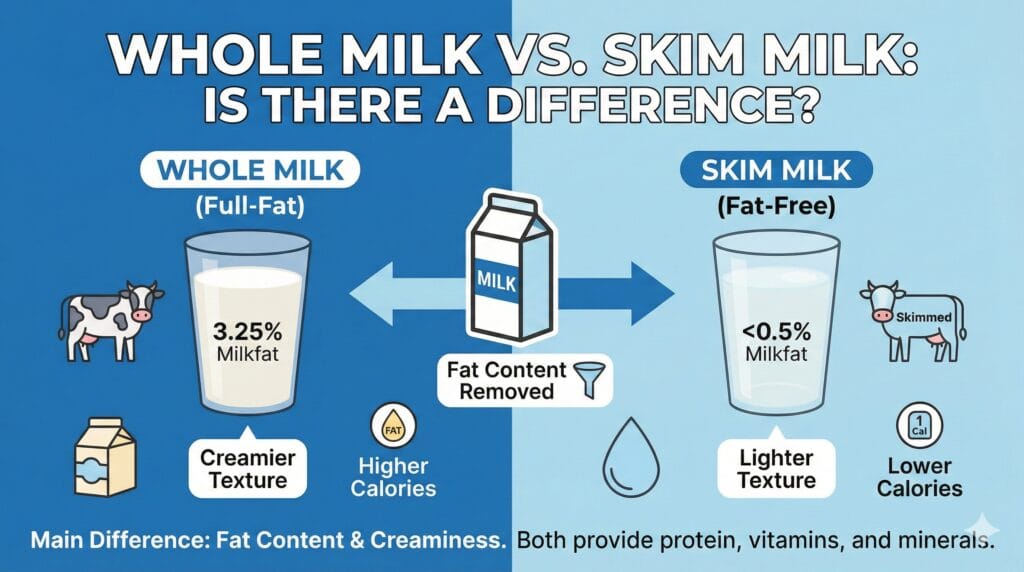
Many owners ask if switching to skim milk or 2% milk makes a difference. They assume the fat in whole milk is the enemy.
While obesity is a massive problem in house cats (we’ll get to that), the immediate enemy is the sugar (lactose).
- Whole Milk: High in fat, high in lactose.
- Skim Milk: Low in fat, still high in lactose.
Switching to skim milk does not solve the lactose intolerance issue. In fact, skim milk can sometimes be higher in sugar by volume than whole milk.
The Calorie Trap
Even if your cat isn’t sensitive to lactose, whole milk is a calorie bomb. A saucer of whole milk for a 10lb cat is roughly equivalent to a human eating an entire 12-inch pizza as a “snack.”
Regularly feeding whole milk is a fast track to feline obesity, which leads to diabetes, arthritis, and a shorter lifespan.
The Exception: Kittens (But Be Careful!)
“Wait,” you might say, “you said kittens have the enzyme!”
Yes, kittens produce lactase. However, cow’s milk is not cat milk. Cow’s milk has a completely different balance of casein (protein) and whey compared to a queen’s (mother cat’s) milk. It also lacks the essential amino acids, like taurine, that kittens need to develop properly.
Veterinary Verdict: If you are hand-rearing a kitten, never use cow’s milk. You must use a Kitten Milk Replacer (KMR), which is scientifically formulated to mimic the nutrient profile of a mother cat.
Safe & Healthy Alternatives to Milk
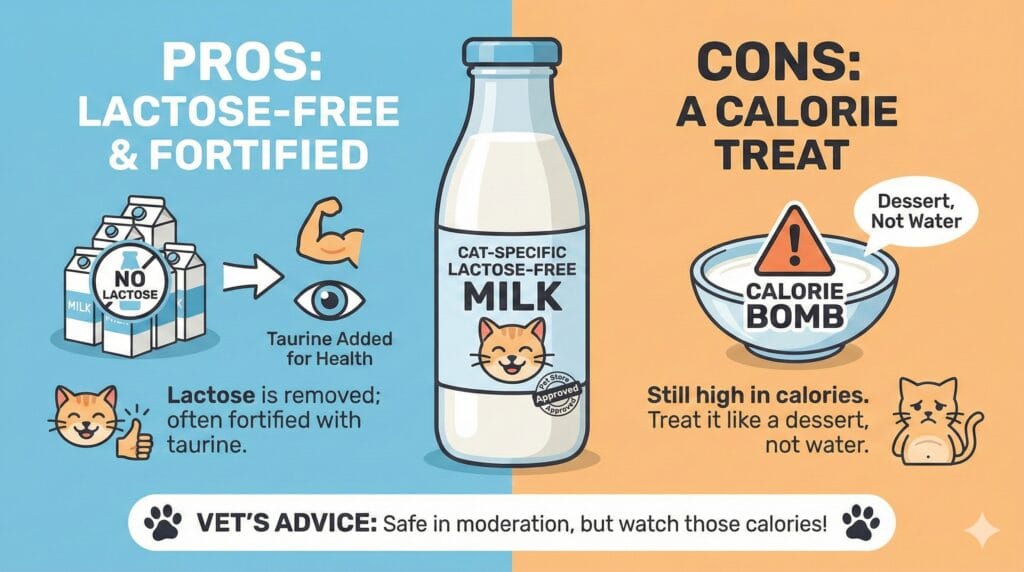
If you want to treat your cat or encourage them to drink more fluids, there are much safer options than the dairy aisle.
1. Cat-Specific Milk
You can buy lactose-free milk specifically made for cats (often found in pet stores).
- Pros: Lactose is removed; often fortified with taurine.
- Cons: Still high in calories. Treat it like a dessert, not water.
2. Bone Broth (The Vet’s Favorite)
This is my top recommendation. Unsalted, onion-free, garlic-free bone broth is fantastic.
- Why it wins: It’s hydrating, rich in collagen, and cats go crazy for the savory meat taste (which they prefer over sweet milk anyway).
3. Goat’s Milk
Some holistic vets recommend raw goat’s milk because it contains slightly less lactose and different proteins than cow’s milk.
- Verdict: It is easier to digest than cow’s milk, but it still contains lactose. Proceed with caution and only offer tiny amounts.
4. Water (The MVP)
Cats are notoriously bad at drinking water. A fountain is often the best investment you can make for your cat’s kidney health.
The Final Verdict
Can cats drink whole milk? Technically yes, but they really shouldn’t.
The nutritional cons (digestive upset, obesity, nutrient imbalance) far outweigh the pros (a moment of tasty pleasure). As a vet, I want your cat to live a long, comfortable life. The best way to show your love isn’t with a saucer of milk, but with a high-quality meat-based diet and a fresh, bubbling water fountain.
🐱 Next Step for You:
If you are worried your cat isn’t drinking enough water and were using milk to hydrate them, try adding two tablespoons of warm water to their wet food tonight. It releases the aroma of the food and sneaks in extra hydration without the tummy ache!
FAQ about : Can Cats Drink Whole Milk?
Can cats drink almond milk or soy milk?
I generally advise against it. While almonds aren’t toxic, many plant-based milks contain added sugars, stabilizers, or even xylitol (which is toxic). They provide no nutritional benefit to an obligate carnivore
My cat licked my cereal bowl. Should I worry?
A few licks likely won’t hurt. Watch the litter box for the next 12 hours. If you see loose stools, you’ll know your cat is sensitive. If they seem fine, they got away with it—this time.
Is lactose-free human milk okay?
It is safer than regular milk regarding digestion, but it is still nutritionally unbalanced for a cat. It’s “safe” in that it won’t cause diarrhea, but it’s not “healthy.
Some sources:
1. On Lactose Intolerance & Digestive Risks
- Source: PetMD (Reviewed by Veterinarians)
- Topic: Explains the biology of why adult cats lose the lactase enzyme and the specific symptoms of intolerance (vomiting, diarrhea, gas).
- Link: PetMD: Can Cats Drink Milk?
2. On The “Calorie Trap” (The Pizza Analogy)
- Source: PDSA (The People’s Dispensary for Sick Animals – Leading UK Vet Charity)
- Topic: This is the specific source for the comparison that “a saucer of milk for a cat is like eating an entire 12-inch pizza.” It highlights the obesity risk.
- Link: PDSA: Vet Q&A – Can Cats Drink Milk?
3. On Kittens & Milk Replacers (Why Cow’s Milk is Dangerous)
- Source: VCA Animal Hospitals
- Topic: Details why cow’s milk is nutritionally inadequate (wrong protein/fat ratio) for kittens and why commercial Kitten Milk Replacer (KMR) is medically necessary.
- Link: VCA Hospitals: Feeding Orphaned Kittens
4. On Safe Alternatives (Broths & Water)
- Source: Central Texas Veterinary Specialty & Emergency Hospital
- Topic: Recommends cat-specific broths and fresh water as healthier alternatives to dairy.
- Link: CTVSH: Why Cats and Cow’s Milk Don’t Mix
5. On Dehydration Risks
- Source: Cornell University College of Veterinary Medicine
- Topic: Provides authoritative information on how diarrhea (caused by lactose) leads to dehydration, which is particularly dangerous for cats with kidney issues.
- Link: Cornell Feline Health Center: Gastrointestinal Parasites & Symptoms (Note: General GI health section covers the mechanics of malabsorption/diarrhea)