

Table of Contents
There is a nagging question that keeps every proactive cat parent up at night: How long do I really have? When you search for the average age of death for indoor cats, you aren’t just looking for a number.
You love your cat. They aren’t just a “pet”—they are a constant companion, a silent confidant, and a source of genuine joy.
You are looking for a roadmap. You want to know if the 12 to 15 years often cited by textbooks is a biological ceiling or a flexible baseline. In this guide, we are going to dive deep into a cat’s life expectancy, debunk the myths surrounding feline aging, and provide you with a high-performance blueprint to help your cat defy the statistics.
You will learn the specific biological “tipping points,” the environmental triggers of early decline, and the three pillars of longevity that can add years to your cat’s life.
The Invisible Clock and the Fear of the Unknown
I know that feeling in the pit of your stomach. You notice a slight graying around your cat’s muzzle, or perhaps they don’t jump onto the high counter with the same effortless grace they had three years ago. Suddenly, the reality of their mortality hits you.

The problem isn’t just that cats age faster than we do; it’s that they are masters of disguise. In the wild, showing weakness is a death sentence. Your indoor cat has inherited this “survival mask.” They won’t tell you when their kidneys are struggling or when their joints ache. They just keep purring, while the invisible clock ticks.
Most owners rely on “wait and see” medicine. They wait for a symptom to become obvious before acting. By then, the statistical average age of death for indoor cats often becomes a self-fulfilling prophecy. We are here to change that. We are moving from reactive care to proactive mastery.
Why This Matters Now
Statistics are averages of the uninformed. If the average lifespan is 15 years, that includes cats fed low-grade filler, cats living in high-stress environments, and cats who never see a vet until an emergency happens. By being here, you are already separating your cat from the “average.”
Understanding the “Longevity Ceiling”
To break the ceiling, you must first understand it. A cat’s life expectancy is influenced by a combination of genetics (the hand they are dealt) and epigenetics (how you play that hand). While we can’t change their DNA, we have near-total control over their environment.
The Life Stages of an Indoor Cat
Understanding where your cat sits on the timeline allows you to adjust your “defense strategy” accordingly.
| Life Stage | Human Equivalent Age | Focus Area |
| Kitten (0-6 months) | 0 – 10 years | Immune priming & Socialization |
| Junior (7 months – 2 years) | 12 – 24 years | Weight management & Dental habits |
| Prime (3 – 6 years) | 28 – 40 years | Maintenance & Enrichment |
| Mature (7 – 10 years) | 44 – 56 years | Early screening (Kidneys/Thyroid) |
| Senior (11 – 14 years) | 60 – 72 years | Joint support & Cognitive health |
| Geriatric (15+ years) | 76+ years | Palliative comfort & Intensive monitoring |
The Three Pillars of Feline Longevity
1. Precision Nutrition (The Fuel)
The average age of death for indoor cats is frequently shortened by metabolic diseases like diabetes and obesity. Cats are “obligate carnivores.” This isn’t a trendy diet term; it’s a biological mandate. They require taurine and animal-based proteins to survive.
- The Problem with Kibble: Many dry foods are high in carbohydrates. Cats lack the salivary amylase to break down carbs efficiently. This leads to insulin spikes and weight gain.
- The Hydration Gap: Cats have a low thirst drive because their ancestors got moisture from prey. Chronic dehydration is a leading contributor to Kidney Disease—the #1 killer of senior cats.
2. Environmental Optimization (The Fortress)
Indoor cats live longer than outdoor cats (who average only 2-5 years due to trauma and disease), but indoor life has its own risks: boredom and sedentary behavior.
- Vertical Space: Cats need to climb to feel secure.
- The “Predatory Loop”: Hunt, catch, kill, eat, groom, sleep. If you skip the “hunt/catch” (play), the loop breaks, leading to stress-induced illnesses like cystitis.
3. Proactive Diagnostics (The Intelligence)
By the time a cat shows symptoms of kidney disease, 75% of kidney function may already be lost. A cat’s life expectancy is drastically increased when you catch “the big three” early:
- CKD (Chronic Kidney Disease)
- Hyperthyroidism
- Diabetes Mellitus
What the Science Says
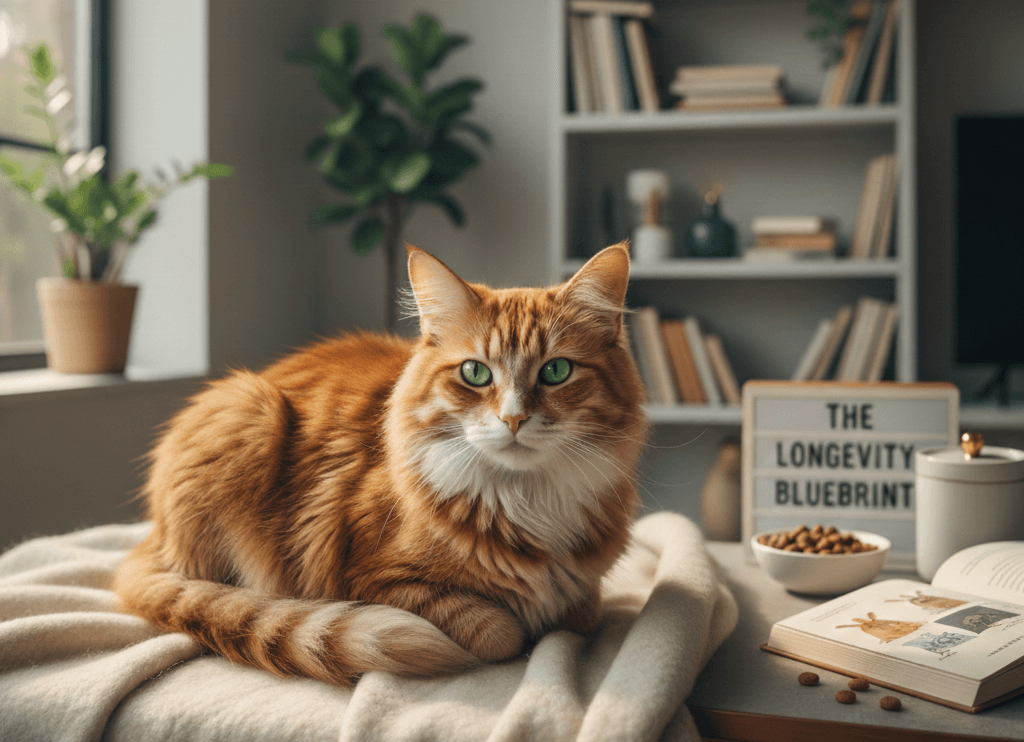
We don’t rely on anecdotes; we rely on clinical data. According to the American Veterinary Medical Association (AVMA) and the Cornell Feline Health Center, the controlled environment of an indoor cat removes the primary “external” causes of death: hit-by-car incidents, predation, and feline leukemia (FeLV) contracted from fighting.
Verified Data Points:
- Weight Matters: A study published in the Journal of Veterinary Internal Medicine found that underweight and overweight cats have shorter lifespans than those kept at an “ideal” body condition score (BCS 5/9).
- Dental Health is Systemic Health: Periodontal disease isn’t just about bad breath. Bacteria from the mouth can enter the bloodstream, causing micro-abscesses in the heart and kidneys.
- The Spay/Neuter Advantage: Neutered males live 62% longer than unneutered males, and spayed females live 39% longer than unspayed females, largely due to the elimination of reproductive cancers and roaming behaviors.
“The key to longevity isn’t just the absence of disease, but the optimization of metabolic function through consistent monitoring.” — General consensus among Feline Practitioners.
Your Step-by-Step Longevity Checklist
To ensure your cat stays well above the average age of death for indoor cats, implement these five steps immediately:
- Switch to High-Moisture Feeding: If you feed kibble, transition to at least 50% high-quality wet food to protect the kidneys.
- Annual Blood Panels (Ages 1-7) / Bi-Annual (Ages 7+): Do not wait for a check-up. Demand an SDMA test, which can detect kidney decline much earlier than standard Creatinine tests.
- Daily Micro-Exercise: Use a wand toy for 10 minutes twice a day. This mimics the “hunt” and prevents the obesity that shaves years off a cat’s life expectancy.
- The “Litter Box Audit”: Monitor output. Increased urination is the “canary in the coal mine” for both diabetes and kidney issues.
- Dental Desensitization: Use a finger brush or dental treats approved by the Veterinary Oral Health Council (VOHC).
Glossary of Terms
- Obligate Carnivore: An animal that must eat meat to survive because its body cannot produce certain essential nutrients (like taurine) on its own.
- SDMA Test: A breakthrough blood test that identifies kidney disease months or even years earlier than traditional methods.
- BCS (Body Condition Score): A 1-9 scale used by vets to determine if a cat is at a healthy weight (5 is ideal).
- Environmental Enrichment: Providing stimuli like scratching posts, toys, and window perches to prevent stress and boredom.
The Close: Defying the Averages

The average age of death for indoor cats—usually cited between 12 and 15 years—is not a sentence. It is a statistical middle ground. By providing species-appropriate nutrition, stimulating their predatory instincts, and insisting on proactive veterinary diagnostics, you are giving your cat the best possible chance to reach their late teens or even their early twenties.
You have the power to influence a cat’s life expectancy starting today. Don’t look at your cat and wonder how much time is left. Look at them and decide how much life you can pack into the years ahead. You are their protector, their provider, and their best bet for a long, happy life.
If you found this guide helpful, please Like and Share it with other cat parents. Every share helps a feline friend live a longer, healthier life!
FAQ: People Also Ask
What is the most common cause of death for indoor cats?
Aside from old age, the leading medical causes are Chronic Kidney Disease (CKD), various forms of cancer (especially Lymphoma), and Heart Disease (Hypertrophic Cardiomyopathy).
Can an indoor cat live to be 20?
Absolutely. With modern veterinary medicine and proper nutrition, reaching 20 is becoming increasingly common. The oldest recorded cat, Creme Puff, lived to be 38!
Does breed affect a cat’s life expectancy?
Yes. Mixed-breed cats (Domestic Shorthairs/Longhairs) often benefit from “hybrid vigor” and tend to live longer than certain purebreds who may be predisposed to genetic conditions.
Should I keep my cat’s food out all day (free-feeding)?
Generally, no. Free-feeding often leads to obesity. Measured, scheduled meals allow you to monitor exactly how much your cat is eating—a vital metric for health
Is it too late to start these habits if my cat is already a senior?
Never. Even small changes in hydration and joint support can significantly improve the quality—and length—of a senior cat’s life.
Further Reading & Sources
- American Veterinary Medical Association (AVMA): Senior Pet Care FAQ
- Cornell Feline Health Center: The Special Needs of the Senior Cat
- Journal of Feline Medicine and Surgery: Longevity and Mortality of Cats in England