Table of Contents
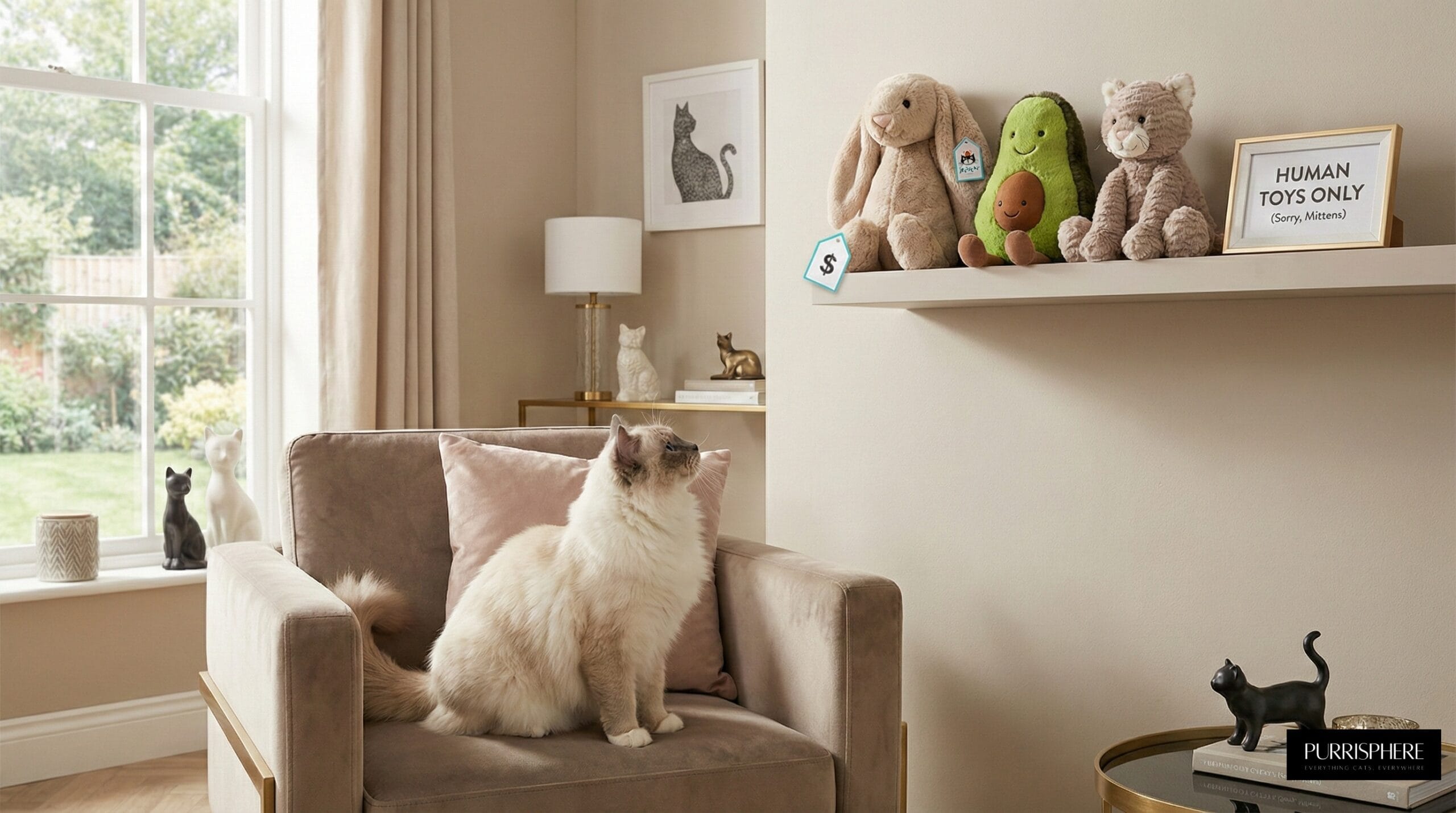
Why are Jellycats so expensive? It’s a question that baffles many cat owners. You spend hundreds on premium kibble, interactive lasers, and vet bills, only to find yourself eyeing a plush croissant with legs that costs as much as a bag of Royal Canin.
If you are a cat lover, you likely have an appreciation for tactile textures—after all, you live with the softest creature on earth. But when you pick up a Jellycat Bashful Bunny or an Amuseable Avocado, the price tag can feel like a hairball in your throat.
In this guide, we’ll break down exactly why these British plush toys command such high prices, whether they are actually safe for your feline friend, and why so many cat owners are starting their own collections (even if their real cats get jealous).
The “Purr-emium” Price Tag: 5 Reasons Why Jellycats Are So Expensive
To the untrained eye, it’s just a stuffed animal. But to collectors and textile experts, a Jellycat is a feat of engineering. Here is the breakdown of where your money goes.
1. Materials Softer Than a Ragdoll’s Belly
The primary driver of cost is the fabric. Jellycat uses proprietary synthetic blends designed to mimic the extreme softness of luxury faux furs.
- The “Petting” Factor: Unlike cheap carnival toys that feel like rough polyester, Jellycats are designed to provide sensory feedback similar to petting a real animal.
- Durability: The fabric piles are denser, meaning they don’t mat or bald easily—a common issue with cheaper toys.
2. High-Stakes Safety Testing (The “Baby Standard”)
Jellycats are expensive because they are rigorously tested to meet European Safety Standard EN71 for all ages, including newborns.
- Why this matters: Achieving “suitable from birth” certification requires expensive pull-testing (ensuring eyes don’t pop off) and chemical testing (ensuring dyes are non-toxic).
- The Cost: This level of safety compliance is far more expensive than the testing required for standard pet toys.
3. The “Retirement” Strategy (Scarcity Economics)
Jellycat operates like a high-end fashion house or a purebred breeder. They release designs in “litters” and then “retire” them without warning.
- Resale Value: Once a design is retired, prices skyrocket on the secondary market. A $25 toy can become a $200 collector’s item overnight.
- FOMO: This scarcity model allows them to maintain high retail prices because buyers view the purchase as an investment rather than a sunk cost.
4. Ethical Manufacturing
Unlike mass-produced generic plushies, Jellycat has a transparent supply chain. They pay higher wages for skilled labor required to hand-finish the intricate stitching on complex shapes (like the spindly legs of an Amuseable or the curved tail of a Bashful Kitty).
5. Original Design IP
You aren’t paying for a generic “bear.” You are paying for the intellectual property of a “Bartholomew Bear.” The brand employs a large team of London-based designers who create eccentric, distinct characters—from grumpy frogs to happy boiled eggs—that are difficult to counterfeit convincingly.
The Big Question: Are Jellycats Safe for Real Cats?
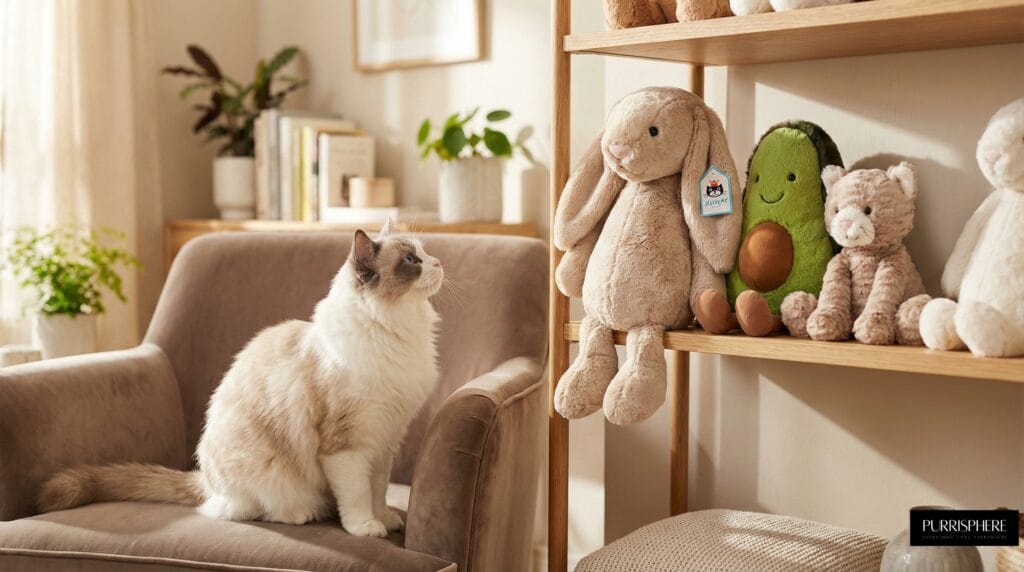
This is critical for every cat owner reading this. You might be tempted to buy a small Jellycat as a luxury toy for your Persian or Maine Coon.
⛔ The Short Answer: NO.
While Jellycats are safe for human babies, they are not designed for cat claws or teeth.
The “Symptoms” of a Cat-Unsafe Toy
If you are evaluating a plush toy for your cat, look for these dangerous signs. Most Jellycats possess all three:
| Feature | Danger Level | Why it’s risky for cats |
| Plastic Eyes | 🔴 High | Hard plastic safety eyes are secured with washers. A determined cat can chew through the fabric, dislodge the eye, and swallow it, causing intestinal blockage. |
| Plastic Beans | 🔴 High | Jellycats are weighted with plastic pellets (beans) in the paws/bum. If a cat rips the seam, these thousands of tiny beads are a major choking hazard. |
| Synthetic Fur | 🟡 Medium | While non-toxic, long-pile synthetic fibers can cause digestive upset if groomed and ingested in large quantities by a cat. |
Expert Note: “Human safety standards focus on pulling and chemical leaching. Pet safety standards focus on chewing and shearing forces. A toy safe for a baby is rarely durable enough for a carnivore’s jaws.”
Why Cat Owners Are Buying Them Anyway
If they aren’t for the cats, why do we see so many “Cat Lady” influencers with shelves full of Jellycats?
1. The “Mini Me” Phenomenon
Cat owners love owning items that resemble their pets. Jellycat’s “Bashful Kitty” and “Fuddlewuddle Cat” ranges come in colors that match real breeds:
- Cream/White: Matches Turkish Vans or Ragdolls.
- Black/Onyx: A perfect match for “void” cats (Bombays).
- Ginger: For the Orange Tabby owners.
2. The “Guilt-Free” Pet
Real cats can be moody. They might scratch you or ignore you. A Jellycat offers the aesthetic and tactile comfort of a pet without the litter box duty, vet bills, or mood swings. It is the perfect “desk pet” for when your real cat refuses to sit on your lap.
3. Aesthetic Home Decor
Cat trees and litter boxes can ruin a room’s aesthetic. Jellycats are “permissible clutter”—they act as decor that signals a love for animals without looking messy.
Practical Advice: How to Collect Jellycats in a Cat Household
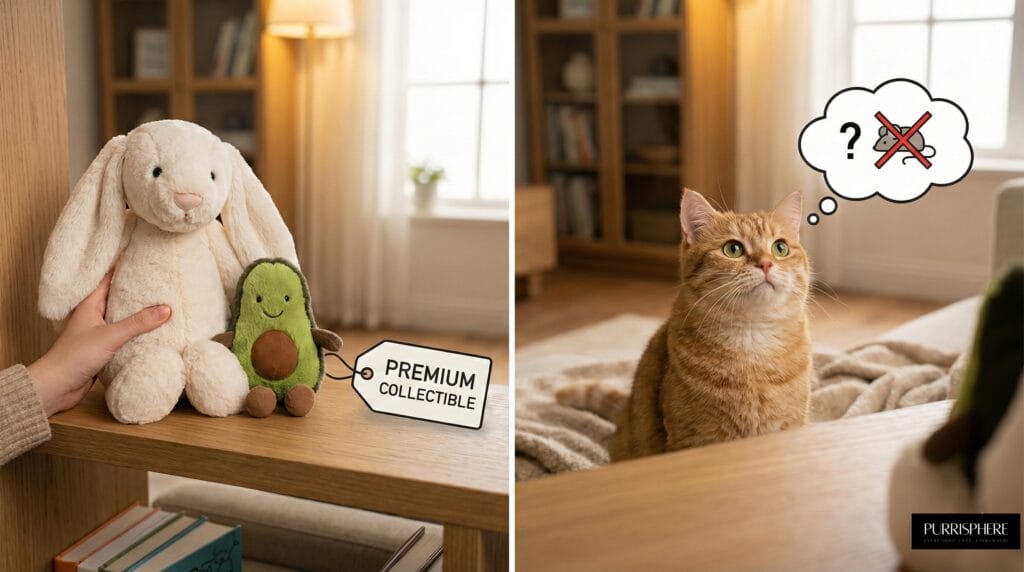
If you decide to invest in these expensive plushies, you need a strategy to keep them safe from your real predator.
Step-by-Step Protection Plan:
- The Scent Test: When you first bring a Jellycat home, let your cat sniff it while you hold it. If they try to groom it or bite it immediately, this toy must live on a high shelf.
- Display Zones: Use floating shelves or glass-fronted cabinets (like an IKEA DETOLF). Cat fur sticks to Jellycat fur like a magnet, and it is notoriously hard to clean.
- Deterrence: Do not spray catnip anywhere near your Jellycat collection. If you handle catnip toys for your real cat, wash your hands before touching your plush collection.
- Repair Protocol: If your cat does puncture a Jellycat, do not just stitch it up. You must ensure no plastic beans have leaked out. If the inner bag of beans is compromised, it is safer to remove all beans and restuff with plain poly-fill before displaying it again.
Comparison: Jellycat vs. Pet Store Toys
Is the premium price ever worth it for a pet?
| Feature | Jellycat (Human Toy) | Premium Pet Store Toy (e.g., KONG) |
| Price | $25 – $150+ | $5 – $20 |
| Stitching | Delicate, invisible seams | Reinforced, double-stitched |
| Eyes | Hard plastic or delicate embroidery | Embroidered or fused fabric |
| Fill | Poly-fill + Plastic Pellets | Dense poly-fill or Crinkle paper |
| Scent | Neutral | Often infused with Catnip |
| Verdict | For YOU | For THE CAT |
Conclusion
So, why are Jellycats so expensive? You are paying for a mix of luxury textile engineering, rigorous safety testing for humans, and a scarcity model that turns stuffed animals into investment assets.
For the cat owner, a Jellycat is a paradox. It is a “cat” that doesn’t eat, scratch, or purr, yet costs as much as a premium vet visit. While they are not safe toys for your feline, they are a wonderful treat for you—a comforting, soft companion that celebrates your love for cute creatures.
Your Next Step: Check your home for “safe zones.” If you plan to buy your first Jellycat (maybe a Bashful Kitty that matches your own?), ensure you have a shelf installed where your real cat can’t knock it down or turn it into an expensive chew toy.
Disclaimer: This article provides information for educational purposes. Always supervise your pets with any plush toys and consult a veterinarian if your cat ingests part of a toy.
Frequently Asked Questions (FAQs)
Can I wash my Jellycat if my cat pees on it?
Yes, but be careful. Hand wash in cold water with mild detergent. Do not use heat or a tumble dryer, as this will melt the synthetic fibers and ruin the “softness” that you paid so much for. Brush the fur with a slicker brush (yes, a cat brush!) while it air dries to restore fluffiness.
Why are the “Amuseable” food Jellycats so expensive?
The Amuseable line (croissants, coffees, vegetables) involves complex pattern cutting. Making a plush toy look like a realistic yet cute pretzel requires more fabric pieces and stitching time than a standard round bear, driving up the labor cost.
Will a Jellycat value go up like a purebred kitten?
Unlike real cats, Jellycats can appreciate in value. Rare, retired designs (like the Fergus Frog or large Dragons) often sell on eBay for 3x–10x their original price. Check the tags: if it says “Retired,” keep it pristine.
Are there any Jellycats safe for cats?
No Jellycat is officially “cat safe.” However, the “Cordy Roy” line is made of corduroy, which is more durable than the soft fur, but it still contains stuffing and beads. Stick to toys made specifically for pets.
Why is the “Jellycat Jack” cat so famous?
Jellycat Jack is the tuxedo cat mascot of the brand. For black and white cat owners, he is the ultimate collectible. His price is high due to his status as the brand icon.
Sources:
Official Jellycat Safety & Care – Jellycat.com (Verifies EN71 safety testing, age suitability, and washing instructions.) https://eu.jellycat.com/safety-care
Why Jellycat Toys Are Expensive – Hayllo (Explains the cost factors regarding premium materials, complex stitching, and original design IP.) https://hayllo.co/blog/why-jellycat-toys-are-expensive/
Safe and Fun Cat Toys – Oregon Humane Society (Expert advice on why plastic eyes, beads, and ribbons are dangerous for cats.) https://www.oregonhumane.org/wp-content/uploads/8.3.17_Cat_Toys.pdf
Jellycat Retired Designs & Value – Cherrie Baby (Details the “retired” status of specific toys which drives up scarcity and resale value.) https://cherriebaby.com.au/collections/jellycat-retired
Jellycat Questions & Manufacturing – After Noah (Covers manufacturing ethics, supply chain transparency, and materials used like plastic beans.) https://afternoah.com/page/our-suppliers/toys/jellycat/jellycat-faqs