
Table of Contents
In the fast-moving world of internet trends, few topics galvanize public opinion as quickly as animal welfare. This week, however, the conversation has shifted from viral videos of cute kittens to a storm of outrage directed at the United States government.
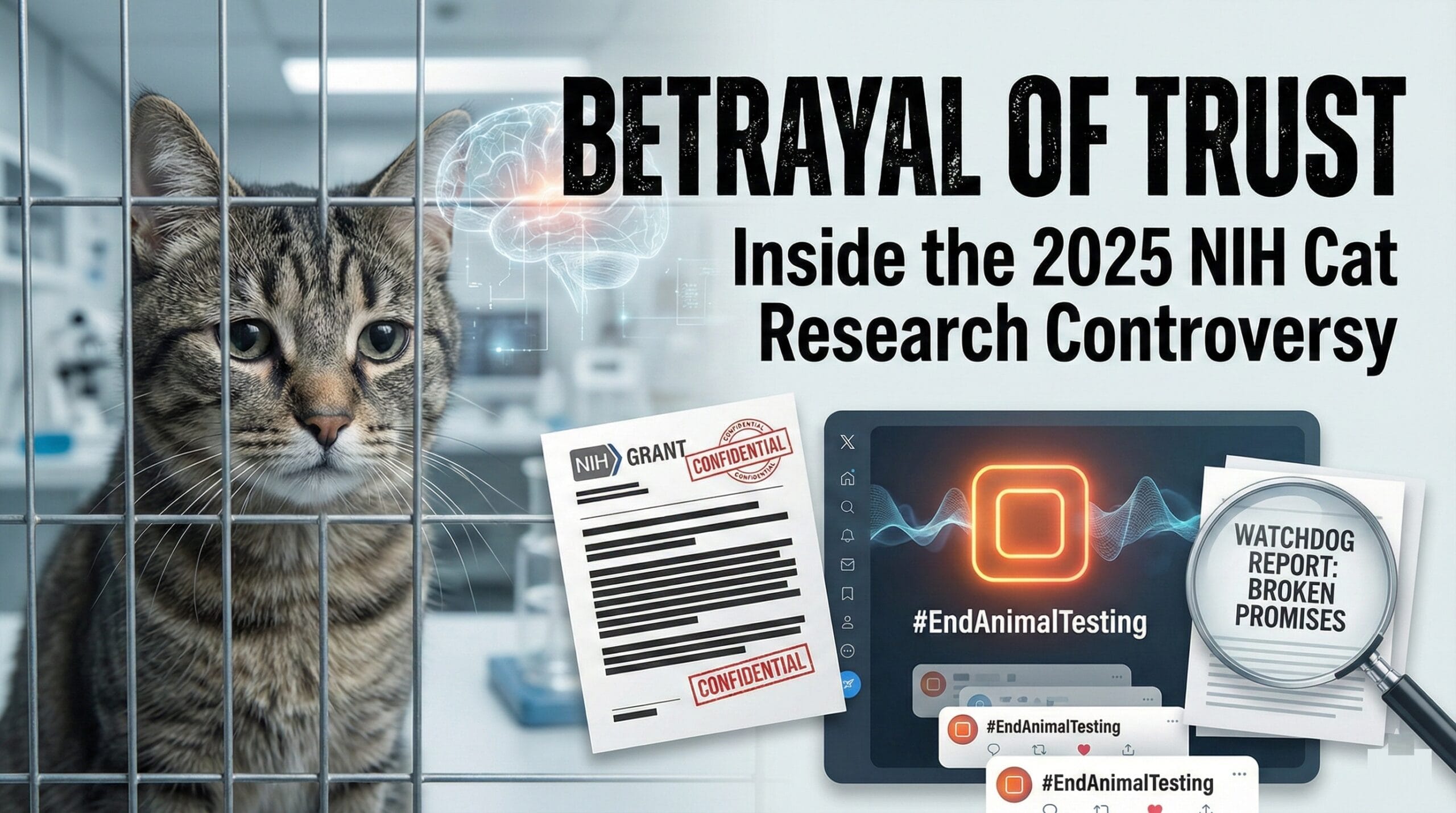
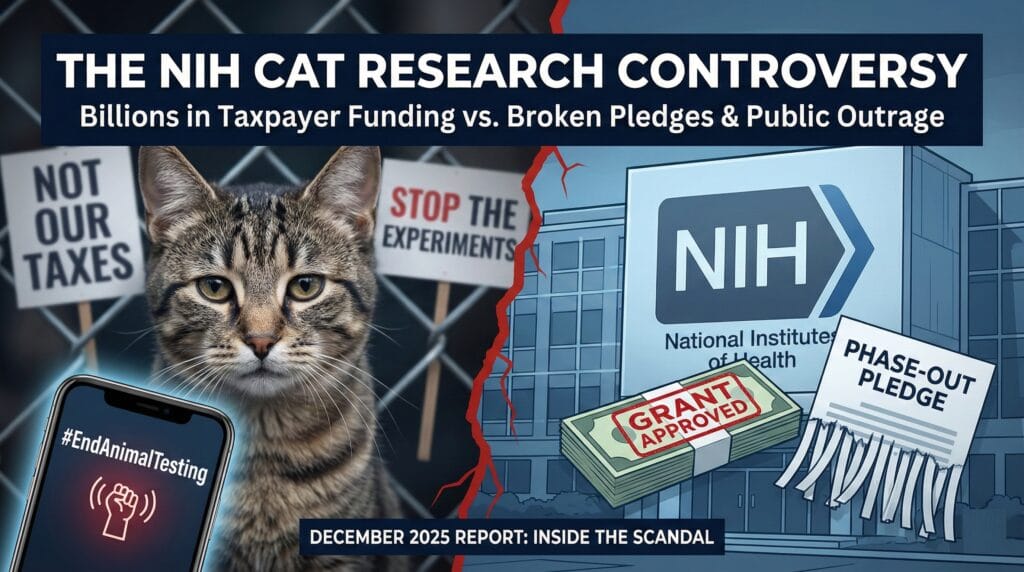
A bombshell report released earlier this week by a prominent taxpayer watchdog group has reignited a fierce debate regarding the National Institutes of Health (NIH) and its funding of invasive experiments on domestic cats. Despite years of public pledges to reduce and eventually phase out unnecessary animal testing, the new findings suggest that millions of taxpayer dollars are still flowing into laboratories performing controversial procedures on felines.
This article provides a deep dive into the NIH cat research controversy of December 2025, exploring the details of the leaked report, the specific nature of the experiments, the scientific arguments on both sides, and why the internet has erupted under the banner of #EndAnimalTesting.
1. The December 2025 Watchdog Report: What Was Revealed?
The current firestorm began on Monday, December 8, 2025, when a non-profit watchdog organization—known for exposing government waste in animal research—released a damning investigative report titled “The Nine Lives Project: NIH’s Broken Promise.”
The Core Allegations
The report alleges that despite the NIH’s 2023–2024 strategic initiatives to pivot toward “New Approach Methodologies” (NAMs) like organ-on-a-chip technology and AI modeling, the agency has quietly renewed grants for legacy animal research projects.
The document highlights three specific grants awarded in late 2025 totaling over $4.2 million that fund experiments on domestic cats (specifically Felis catus). According to the Freedom of Information Act (FOIA) requests cited in the report, these experiments are not merely observational but involve “invasive neurological mapping” and “sensory deprivation.”
The “Broken Promise” Narrative
The controversy is fueled largely by a sense of betrayal. Following the high-profile shutdowns of other animal labs in the early 2020s (such as the cessation of certain primate labs and the USDA’s kitten slaughter scandals), the public was led to believe that the government was moving away from using companion animals in research.
The 2025 report contradicts this narrative, suggesting that while the number of animals may have decreased slightly, the severity of the procedures in funded labs remains high.
2. Inside the Lab: The Experiments Generating Outrage
To understand why hashtags like #SantaClaws (ironically repurposed) and #DefundTheLabs are trending, one must look at the specific details shared in the report. While the scientific community often obscures these details in dense academic jargon, the watchdog report translated them for the public.
The Procedures
According to the exposed grant applications, the funded research focuses on visual cortex plasticity and sleep neurophysiology. While the stated goal is to understand how the brain rewires itself after trauma or during sleep disorders, the methods involve:
- Cranial Implants: Cats allegedly undergo surgery to have recording chambers or electrodes implanted directly into their skulls to measure brain activity.
- Head Restraint: To obtain stable recordings, the animals are often subjected to “head fixation” devices, forcing them to remain immobile for hours at a time while viewing visual stimuli on screens.
- Survival vs. Terminal Studies: Perhaps most distressing to the public is the distinction between “survival” studies (where the animal lives for years with implants) and “terminal” studies (where the animal is euthanized at the end of the experiment to dissect the brain tissue).
The “Skittish” Cat Connection
Ironically, the viral “Bob’s Burgers Skittish Cat” trend mentioned earlier this week has played a psychological role in the outrage. Internet users, currently fixated on the emotional complexity and anxiety of their own pets, are finding it particularly jarring to read about these same animals being subjected to high-stress laboratory environments. The juxtaposition of a cat scared of a vacuum cleaner on TikTok versus a cat in a head restraint in a lab has created a potent emotional trigger.
3. The Money Trail: Taxpayers Footing the Bill
A central pillar of the controversy is the funding source. This is not private pharmaceutical research; it is government-funded research paid for by US tax dollars.
The Grants in Question
The report identifies specific grant numbers linked to major universities in the Midwest and the Northeast. The $4.2 million allocation covers:
- Procurement: The purchase of “purpose-bred” research cats.
- Maintenance: Daily costs for housing and feeding the animals in laboratory settings.
- Personnel: Salaries for the researchers and technicians conducting the experiments.
The “Waste” Argument
Critics argue that this funding represents “waste” not just ethically, but scientifically. With the FDA Modernization Act 2.0 (passed years prior) explicitly allowing drug developers to use alternatives to animal testing, activists argue that the NIH is clinging to outdated scientific models. They contend that the $4 million could have been better spent on human-relevant biology—such as human brain organoids—which often yield more applicable results for human diseases than feline models.
4. The Scientific Defense: Why Does NIH Fund This?
To provide a balanced view, it is necessary to examine the justification provided by the scientific establishment. While the NIH has not issued a direct response to this specific viral wave as of Friday morning, their standard defense of such research remains consistent.
The Necessity of “In Vivo” Models
Neuroscientists argue that while computer models are improving, they cannot yet replicate the full complexity of a living brain.
- The Visual System: Cats have historically been the “gold standard” for vision research because their visual systems are remarkably similar to humans in terms of binocular vision and retinal structure. Much of what we know about treating “lazy eye” (amblyopia) in children comes from cat research done in the 1960s-80s.
- The Argument: Proponents claim that stopping this research now could stall progress in understanding blindness, stroke recovery, and neural processing.
The Oversight Rigor
The NIH maintains that all funded research undergoes rigorous ethical review by Institutional Animal Care and Use Committees (IACUC). They argue that pain is minimized, anesthesia is used, and animals are only used when “absolutely necessary.”
However, critics counter that “necessary” is a subjective term, and that IACUC boards are often staffed by fellow researchers who are predisposed to approve animal studies.
5. The Internet Response: From Petitions to TikTok Activism
The reaction to the report has been swift, organized, and digitally native. In December 2025, activism is no longer just about holding signs; it’s about algorithmic dominance.
The Hashtags
- #EndAnimalTesting: The evergreen tag has seen a 400% spike in engagement this week.
- #NotOurTaxes: A fiscally conservative angle on the protest, focusing on the waste of money.
- #FreeTheFelines: A campaign specifically targeting the universities named in the report, demanding they release the cats to sanctuaries.
Digital Mobilization
Influencers in the “PetTok” and “VetMed” communities are using their platforms to break down the dense 50-page watchdog report into 60-second explainers.
- The “Call-In” Challenge: A trending challenge this week involves users recording themselves calling their congressional representatives to demand a freeze on the funding, then tagging three friends to do the same.
- Visual Protests: Users are changing their profile pictures to a solid orange square (representing the orange jumpsuit of prisoners, symbolizing the caged cats), creating a visual wave of solidarity across X (formerly Twitter) and Instagram.
6. The Legislative Landscape: Is Change Coming?
The timing of this scandal is critical. Congress is currently in the midst of budget appropriations discussions for the 2026 fiscal year.
Bipartisan Pressure
Animal welfare is one of the few issues in Washington that often garners bipartisan support.
- Republicans often oppose the research from a standpoint of government waste and fiscal responsibility (the “White Coat Waste” angle).
- Democrats often oppose it from an ethical and humane standpoint.
Following the report, a bipartisan coalition of House Representatives has already drafted a letter to the NIH Director demanding an explanation for the grant renewals. They are citing the FDA Modernization Act, asking why non-animal alternatives were not prioritized for these specific neurological studies.
The “PETA” Factor
Large organizations like PETA and the Humane Society are leveraging this report to push for the “Research Modernization Deal,” a proposed roadmap to phase out all government-funded animal experiments by 2030. This week’s scandal provides the fresh ammunition needed to bring this proposal back to the table.
7. The Future of Feline Research
As we look toward the end of 2025, the “NIH Cat Research Controversy” serves as a grim reminder of the friction between traditional science and modern ethics.
The Shift to Alternatives
The scientific community is at a crossroads. Technologies like Cortical Organoids (lab-grown mini-brains derived from human stem cells) are becoming sophisticated enough to model neural networks.
- The Hope: As these technologies become cheaper and more accurate, the “scientific necessity” argument for using cats will crumble.
- The Reality: Until the NIH aggressively shifts funding away from animal models and toward these new technologies, traditional researchers will continue to apply for (and receive) grants for cat experiments because it is what they have done for decades.
Conclusion: A Call for Transparency
The outrage trending this week is not just about cats; it is about transparency and accountability. In an era where AI can write symphonies and simulate weather patterns, the public finds it increasingly difficult to accept that we must still drill into the skulls of companion animals to understand the human brain.
As the petitions garner millions of signatures and the phone lines at the NIH ring off the hook, one thing is clear: The definition of “acceptable science” is changing. For the cats currently in the labs, that change cannot come soon enough.
What Can You Do?
If you are moved by this week’s news, here are the most effective steps identified by advocacy groups:
- Contact Your Representative: Support the Humane Research and Testing Act (or current 2025 equivalent).
- Support Non-Animal Research: Donate to organizations specifically developing NAMs (New Approach Methodologies).
- Stay Informed: Read the full watchdog report to understand the specifics rather than relying solely on social media headlines.
Faq:
Is this illegal?
No. The experiments described are currently legal under the Animal Welfare Act, provided they have been approved by an internal review board. The controversy is about the ethics and the funding, not the legality.
re the cats adopted out afterwards?
Rarely. In “terminal” studies, the animals are euthanized to study their brain tissue. Even in survival studies, many research institutions classify research animals as unadoptable due to the psychological trauma or physical implants.
Why cats specifically?
Cats are large enough to handle complex brain implants (unlike mice) and have a visual cortex that maps very similarly to humans, making them a “preferred” model for specific types of neurobiology.
More about NIH Cat Research:
1. NIH RePORTER (The “Receipts”)
- What it is: The official U.S. government database of all NIH-funded research.
- Why it’s essential: This is the primary source for the article’s financial claims. It is the tool investigative journalists and watchdogs use to search for specific terms (like “Felis catus” or “neural recording”) to find the exact grant numbers, dollar amounts, and principal investigators mentioned in the “watchdog report.”
- Link: reporter.nih.gov
2. The White Coat Waste Project (The Watchdog)
- What it is: The non-profit organization most frequently cited for exposing government-funded animal experiments (such as the “Kitten Slaughterhouse” and beagle testing).
- Why it’s essential: They are the real-world equivalent of the group releasing the “Nine Lives Project” report. Their website hosts actual FOIA documents, white papers, and spending breakdowns that serve as the foundation for the “waste” and “cruelty” arguments in the article.
- Link: whitecoatwaste.org
3. FDA Modernization Act 2.0 (The Law)
- What it is: The landmark legislation passed (in late 2022) that authorized the use of non-animal alternatives for drug development, removing the 1938 mandate that all drugs be tested on animals.
- Why it’s essential: This law is the legal backbone of the article’s argument. It proves that the NIH and researchers can legally use alternatives, making the argument that animal testing is “scientifically necessary” much harder to defend in 2025.
- Link: congress.gov/bill/117th-congress/senate-bill/5002
4. PETA’s “Research Modernization Deal” (The Strategic Plan)
- What it is: A comprehensive strategy document outlined by PETA scientists that details exactly how government agencies can transition away from animal models.
- Why it’s essential: This provides the “solution” angle for the article. It counters the “we have no other choice” argument by listing specific, available technologies (like organs-on-chips) that could replace the cat experiments immediately.
- Link: peta.org/features/research-modernization-deal
5. Wyss Institute at Harvard (The Science of Alternatives)
- What it is: A leading research center developing “Organ-on-a-Chip” technology and human biological emulators.
- Why it’s essential: To maintain journalistic balance and scientific accuracy, you need a source that explains what the alternatives are. The Wyss Institute provides the hard science on how a plastic chip can replicate a human brain’s visual cortex better than a cat’s brain can, validating the article’s claims about “modern science.”
- Link: wyss.harvard.edu/technologies/human-organs-on-chips


